What is IR35? The UK rules explained in plain English
IR35 decides whether HMRC treats you as genuinely self-employed or as an employee for tax purposes. Here is what the rules actually say.

IR35 is a piece of UK tax legislation. It has been causing contractors headaches since the year 2000, and it remains one of the most misunderstood areas of UK tax law. If you work through a limited company or as a freelancer, understanding IR35 is not optional — it directly affects how much of your contract income you actually keep.
This guide covers the IR35 meaning, how the rules work in practice, what inside and outside IR35 actually mean for your take-home pay, and who is responsible for making the call. No legal jargon. No unnecessary complexity. Just the information you need to make sense of where you stand.
What does IR35 mean?
IR35 gets its name from the Inland Revenue press release that introduced it — press release number 35, published in 1999, ahead of the legislation coming into effect in April 2000. The formal name is the off-payroll working rules, though most people in the contracting world still call it IR35.
The IR35 meaning, in plain English, is this: HMRC uses it to identify contractors who are operating like employees but paying tax as if they are genuinely self-employed. The legislation was designed to tackle what HMRC calls disguised employment — a situation where someone works day to day exactly like a member of staff, but routes their income through a limited company to pay a lower rate of tax.
If HMRC determines that your working relationship with a client looks like employment, you fall inside IR35. Your income is then taxed through PAYE, much like a regular employee, rather than through the more tax-efficient limited company route. If your arrangement is genuinely self-employed and you are providing a service as an independent contractor, you fall outside IR35 and retain the tax advantages of trading through a company.
The financial difference between the two positions is substantial. At a day rate of £500, working outside IR35 typically yields 20 to 25 per cent more take-home pay than working inside IR35 at the same rate. That gap is why contractors care so much about their IR35 status, and why getting it right matters.
What are the IR35 rules?
The IR35 rules do not come down to a single test. Status is assessed by looking at the overall nature of the working relationship between you and the end client. Three factors carry the most weight, and they are the same three factors that employment law has used for decades to distinguish employees from independent contractors.
Personal service and the right of substitution
Can you send someone else to do the work in your place? A genuine right of substitution, where you could reasonably send a suitably qualified colleague instead of turning up yourself, is one of the strongest indicators of outside IR35 status. If the contract requires you personally to do the work, with no real ability to substitute, that points toward the kind of personal service that characterises employment. The substitution right must be real and commercially credible, not just a clause added to look good on paper.
Control
Does the client control how, when and where you do the work? Employees are directed by their employer. Contractors are engaged to deliver an outcome. If the client tells you what hours to work, dictates your methods, requires you to sit in a specific office, and manages your day-to-day activity like a line manager would, that looks like employment. Outside IR35 contractors typically have significant autonomy over how the work gets done — the client cares about the deliverable, not the process.
Mutuality of obligation
Mutuality of obligation (MOO) is the trickiest of the three tests, and it is also the one that HMRC's own CEST tool does not assess. The question is whether there is an ongoing obligation on both sides: is the client obliged to keep offering you work, and are you obliged to keep accepting it? A true employment relationship implies that kind of continuity. A genuine contract-to-contract arrangement, where either side can walk away without penalty at the end of each engagement, points toward self-employment and outside IR35 status.
Other factors
Beyond the three main tests, several secondary factors inform the IR35 determination:
- Financial risk: do you bear financial risk if the work is unsatisfactory or delivered late?
- Equipment: do you use your own tools and equipment, or the client's?
- Integration: how embedded are you in the client's organisation, culture and management structure?
- Exclusivity: are you free to work for multiple clients at once, or are you tied to one organisation?
No single factor is decisive. HMRC and the courts look at the whole picture. A contract that is strong on substitution but weak on control may still fall inside IR35 if the overall arrangement looks like employment. That is why working practices and contract wording both need to align with outside IR35 status, not just one or the other.
Inside vs outside IR35: what the rules mean for your pay
| Factor | Inside IR35 | Outside IR35 |
|---|---|---|
| Tax treatment | Full PAYE: income tax plus employee and employer NI | Salary and dividends through a limited company |
| Who decides status | End client (medium and large businesses, post-2021) | End client or contractor (small company exemption) |
| Take-home pay | Roughly 50–55% of gross contract value | Typically 70–75% of gross at the same day rate |
| Expenses | Very limited; no travel to the regular workplace | Legitimate business expenses deductible |
| Admin | Low — the umbrella handles payroll | A limited company and an accountant are required |
The table above captures the main differences, but the numbers deserve spelling out. At a day rate of £500, outside IR35 through a limited company typically returns between £7,000 and £8,000 per month in take-home pay. The same rate inside IR35 through an umbrella company typically returns between £5,500 and £6,000 per month. That gap — £18,000 to £30,000 a year at a single rate — is why IR35 status is so financially significant.
The rule of thumb contractors use is a 20 per cent rate uplift. To achieve equivalent take-home to a £500 outside IR35 contract, you generally need around £600 per day inside IR35. That figure shifts depending on pension contributions and individual circumstances, but it gives you a useful starting point when comparing offers. If you want to run the exact numbers for your own situation, the IR35 take-home calculator lets you toggle between inside and outside scenarios with your own day rate.
Who decides your IR35 status?
The answer to this question changed significantly in 2017 and again in 2021, and it depends on the size of the business you are contracting for.
Before the 2017 and 2021 reforms
From 2000 to 2017, contractors were responsible for assessing their own IR35 status. You decided whether your contract fell inside or outside IR35 and paid tax accordingly. This arrangement attracted criticism that it was easy to abuse, and that many contractors were choosing outside IR35 status without genuinely meeting the criteria.
Post-2017: public sector
In April 2017, the rules changed for public sector contracts. The responsibility for determining IR35 status shifted from the contractor to the end client — the public sector organisation engaging them. If the client said the contract was inside IR35, that determination applied. Contractors lost the ability to make their own call.
Post-2021: private sector
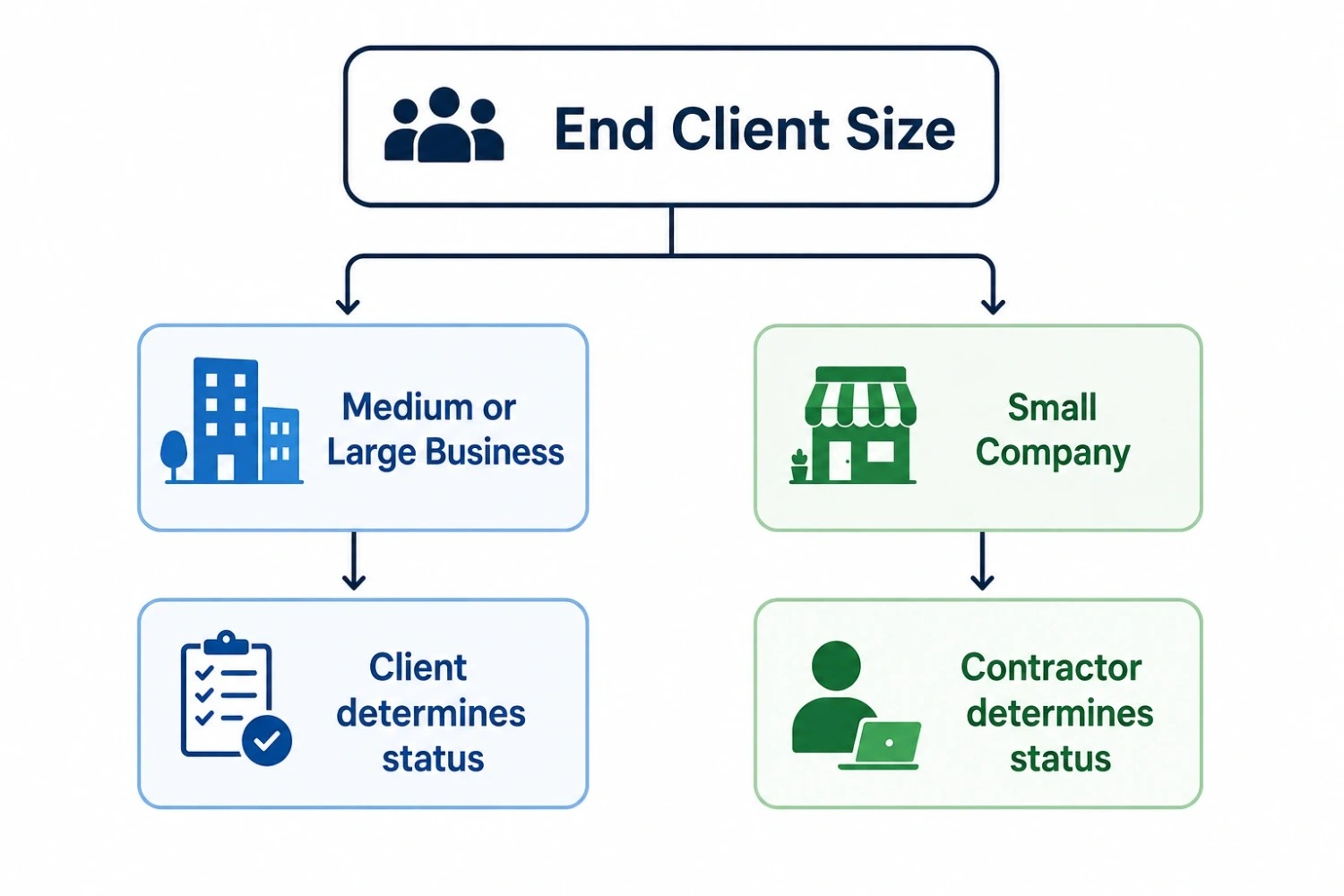
In April 2021, the same reform was extended to medium and large businesses in the private sector. Under the current IR35 rules, if you are working for a medium or large company, that company is responsible for determining your IR35 status and issuing a Status Determination Statement (SDS). You can challenge the SDS if you disagree, but the client's determination stands unless they change it.
The small company exemption
There is one important carve-out. Small companies are exempt from the 2021 off-payroll working rules. A company qualifies as small if it meets at least two of these three criteria: annual turnover below £10.2 million, a balance sheet total below £5.1 million, and fewer than 50 employees. Where the small company exemption applies, the contractor still determines their own IR35 status, as things worked before 2017. This matters a great deal if you work primarily with smaller clients.
IR35 changes and history
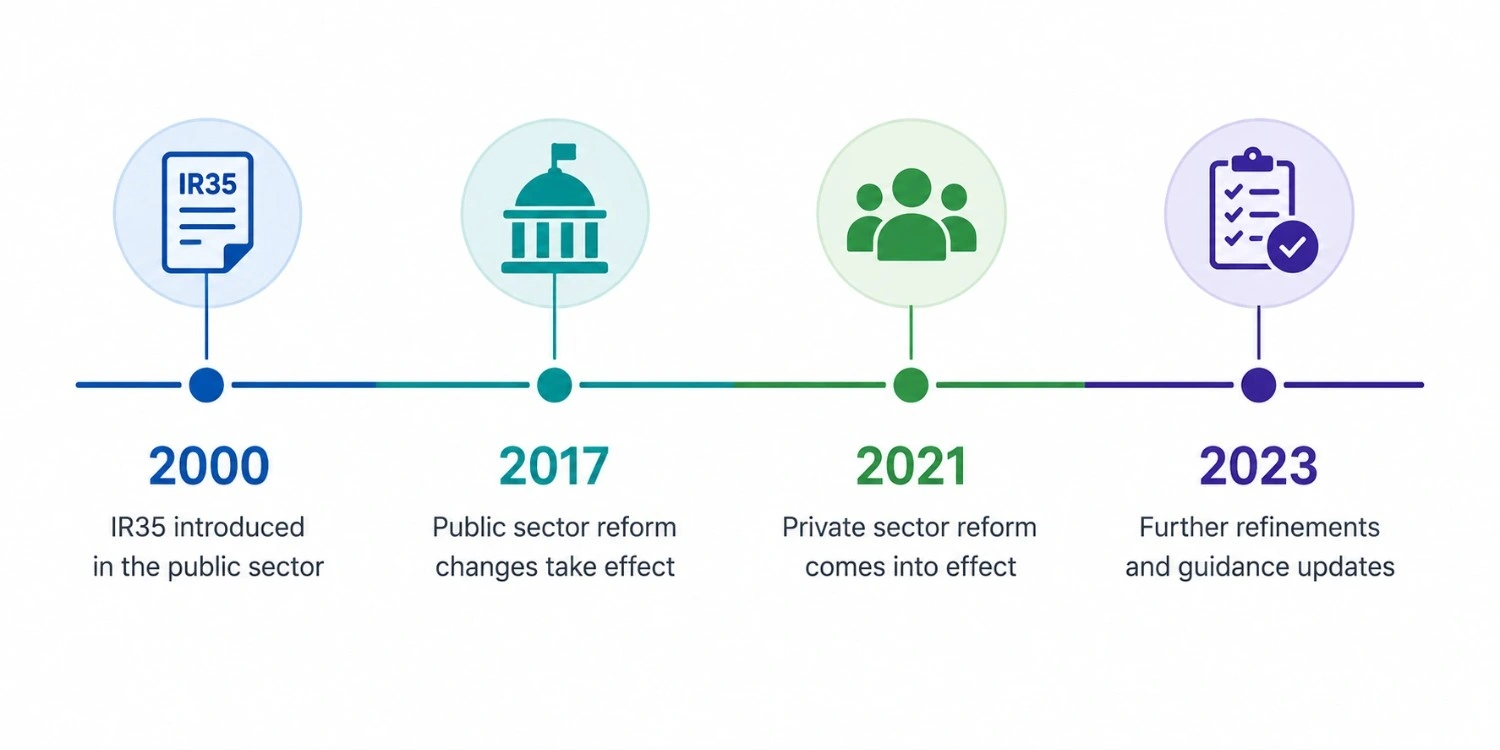
IR35 legislation was introduced. Contractors self-determined their own status.
Public sector reform. End clients became responsible for determining the status of public sector contracts.
Private sector reform. Medium and large businesses became responsible for issuing status determinations.
The government confirmed IR35 is here to stay after a short-lived repeal announcement in 2022.
IR35 changes timeline, from introduction in 2000 to the 2021 private sector reform.
One question that comes up regularly is whether IR35 is being abolished. In September 2022, the government briefly announced it would repeal the 2017 and 2021 off-payroll reforms. That plan was reversed within weeks. IR35 legislation remains fully in force, and the 2021 reforms are not going anywhere.
IR35 assessment: how is status determined?
IR35 status is not a calculation; it is a legal judgment based on the facts of the working relationship. There are two main routes to getting that determination.
HMRC's CEST tool
HMRC provides a free online tool called Check Employment Status for Tax. It asks a series of questions about how you work and returns a determination. It is the official starting point for most status assessments, and if you follow it correctly and in good faith, HMRC will generally stand by the result — unless the information provided was inaccurate.
CEST has known limitations. It does not assess mutuality of obligation, which is one of the three primary IR35 tests, and it does not handle every edge case that comes up in complex contracts. For straightforward engagements it is a reasonable starting point. For anything more nuanced, a professional review is worth considering. You can check your IR35 status using the HMRC CEST tool directly on the HMRC website.
Independent IR35 review
An independent specialist can assess your actual contract and working practices and give a more thorough determination. This is particularly useful for high-value contracts, for challenging an SDS you disagree with, or for roles where the working arrangements are complex. If a client insists you are inside IR35 and you believe that determination is wrong, a detailed independent assessment gives you evidence to support a challenge.
For a full walkthrough of the assessment process, including the IR35 checklist and what to do with a CEST result, the IR35 checker guide covers each step in detail.
IR35 compliance: what you need to do
Whether you are a contractor or an end client, IR35 compliance means different things.
For contractors
- Understand your current IR35 status. If you are inside IR35, make sure you are being taxed correctly through PAYE.
- If you believe you are outside IR35, make sure your contract wording and actual working practices both support that position. A contract that says outside IR35 but working practices that look like employment will not hold up to scrutiny.
- Keep records of how you actually work — the evidence you would need in an HMRC investigation.
- Consider an IR35 review for any high-value contract, particularly if the client is medium or large.
For hirers
- Issue a Status Determination Statement for every contractor engagement. This is a legal requirement under the 2021 rules if you are a medium or large business.
- Have a formal process for contractors to challenge your SDS if they disagree.
- Review your existing contractor arrangements. A blanket "all inside IR35" approach creates risk and may result in talent drain.
For more detailed guidance on the legislation itself, the HMRC employment status manual sets out the full technical basis for how status determinations are made.
IR35 and different types of workers
IR35 does not affect every type of worker equally. The rules were specifically designed for personal service companies — limited companies with a single director-contractor providing services to one or more clients.
- Limited company contractors: this is the core target of the legislation. If you trade through a personal service company, IR35 applies to you directly.
- Umbrella company workers: umbrella companies are already inside IR35 by design. The umbrella is the employer and you are an employee. IR35 status does not change anything about how you are taxed through an umbrella.
- Sole traders: IR35 does not typically apply, because the legislation targets the limited company structure specifically. HMRC may still investigate employment status for sole traders under different rules, but IR35 is not the mechanism.
Our full breakdown of who IR35 applies to covers each worker type in more detail.
The bottom line on IR35
IR35 is not something you can ignore if you work through a limited company in the UK. The legislation affects your take-home pay, determines how your income is taxed, and — since the 2021 reform — puts the responsibility for getting it right on the shoulders of your end client, not just you.
Understanding the IR35 rules means knowing the three tests, understanding who is responsible for the determination, and making sure your contract and working practices are consistent with your claimed status. If you are outside IR35, that position needs to be defensible both on paper and in practice.
If you are in the middle of deciding whether to take a contract, or trying to understand what your current arrangement means for your tax position, start with the numbers. The IR35 take-home pay calculator lets you compare inside and outside IR35 at your own day rate, so you know exactly what is at stake before you make any decisions.
IR35 FAQs
No. The government briefly announced a repeal of the 2017 and 2021 off-payroll reforms in September 2022, but reversed the decision within weeks. IR35 legislation is fully in force and there are no current plans to change it.
IR35 was designed for personal service company contractors who trade through a limited company. Sole traders are not directly caught by IR35, though HMRC can still investigate employment status through other mechanisms.
An SDS is a formal written document that a medium or large business must issue to any contractor it engages, stating whether the contract falls inside or outside IR35 and giving reasons. It became a legal requirement under the 2021 off-payroll working rules.
HMRC can open an IR35 enquiry at any time. If it determines you should have been inside IR35, you could face a bill for unpaid income tax, National Insurance, interest and penalties. That is why keeping clear evidence of your working practices matters.
Yes. IR35 status is assessed contract by contract, not person by person. You could have multiple contracts running simultaneously with different IR35 statuses, depending on how each engagement is structured.
Small companies — those meeting at least two of the following: turnover below £10.2m, balance sheet below £5.1m, fewer than 50 employees — are exempt from the 2021 off-payroll rules. Where the exemption applies, the contractor determines their own IR35 status.
Disguised employment is the term HMRC uses for the situation IR35 was designed to tackle: a contractor who works day to day exactly like an employee but routes income through a limited company to pay less tax. If the working relationship looks like employment, HMRC treats it as employment for tax purposes.
See what you would actually take home.
Enter your day rate once and compare inside and outside IR35 side by side. Free, no signup.