IR35 Calculator: work out your take-home pay inside or outside IR35
You are a contractor. You want to know what you actually take home. This calculator does that. Enter your day rate or annual contract value, tell the tool whether you are inside or outside IR35, and you will see your estimated take-home pay in seconds.
- 2025/26 tax rates
- Inside vs outside comparison
- No email required
What do you actually keep?
Enter your rate once. See inside and outside IR35 side by side.
Day rate or annual contract value
The gross amount your client pays you, before tax or deductions.
IR35 status
Switch between inside and outside IR35 to see how each affects your take-home pay.
Working structure
Outside IR35 contractors almost always run through a limited company to take advantage of dividend tax treatment.
Pension contribution (salary sacrifice)
Reduces your taxable income before tax and National Insurance are calculated.
Tax code
1257L gives the standard £12,570 tax-free personal allowance.
Limited company expenses
Outside IR35 only. Legitimate annual costs that reduce your corporation tax bill.
Salary vs dividend split
Outside IR35 only. Override the default low-salary, high-dividend structure.
Workplace pension auto-enrolment
Inside IR35 only. Minimum statutory contribution via the umbrella.
Holiday pay treatment
For umbrella contractors. Whether holiday pay sits inside your headline rate or accrues on top.
Your take-home pay
Outside IR35Inside vs outside, side by side
Annual figures at your rate, so you can see exactly where the difference comes from.
Quick summary
Required rate uplift
The day rate you would need on the other side of IR35 to land in the same financial position.
Assumptions this calculator makes
- 2025/26 UK tax bands: personal allowance £12,570, basic rate 20% to £50,270, higher rate 40% to £125,140, additional rate 45% above.
- Personal allowance reduces by £1 for every £2 earned above £100,000, and is fully removed at £125,140.
- Employee National Insurance: 8% between the primary threshold and £50,270, then 2% above.
- Employer National Insurance (inside IR35 / umbrella): 15% above the secondary threshold, deducted from the contract value before you are paid.
- Apprenticeship levy: 0.5% of gross pay, applied to umbrella contracts.
- Dividend tax: 8.75% basic, 33.75% higher, 39.35% additional, after a £500 dividend allowance.
- Outside IR35: salary defaults to the personal allowance, with the remainder drawn as dividends after corporation tax at 19–25%, less any expenses entered.
- Auto-enrolment pension and umbrella fees are deducted from gross pay before tax where selected.
- Figures are estimates for comparison only, not a substitute for advice from an accountant or tax adviser.
This tool estimates take-home pay. It does not determine your IR35 status.
How to use the IR35 calculator
- Enter your day rate or annual contract value. Type in the gross amount your client pays you, before tax or deductions.
- Select your IR35 status. Switch between inside IR35 and outside IR35 to see how each status affects your take-home pay.
- Choose your working structure. Inside IR35: pick an umbrella company or a limited company. Outside IR35: the calculator defaults to a limited company.
- Add optional details. Enter your pension contribution (salary sacrifice), student loan plan, and actual working days per year.
- Read your results. The calculator shows your take-home pay, income tax, employee NI, employer NI, and effective tax rate — broken down monthly and annually.
- Compare both scenarios. Toggle between inside and outside IR35 to see the take-home difference at your rate. Useful when weighing up two contract offers.
Why IR35 calculators give different results
Tried a few IR35 calculators and got different numbers from each? That is normal. The tax rates are the same everywhere. The differences come from the assumptions each tool makes.
Working days are the biggest one. Some tools assume 260 days a year. Most contractors actually work 220 to 234 days once you account for bank holidays, gaps between contracts, and sick days. That gap can push gross income up by 10 to 15 per cent, which is why one calculator can look so different from another on the same day rate.
Other variables include the apprenticeship levy (umbrella companies pass this on to inside IR35 workers), how pension salary sacrifice is treated, and whether the tool accounts for the 60 per cent effective tax rate between £100,000 and £125,140.
Our calculator is clear about its assumptions. To understand the three tests that determine your IR35 status in the first place, HMRC's Check Employment Status for Tax tool is the official starting point, though it has known gaps around mutuality of obligation, which we cover below.
What does inside IR35 mean?
Inside IR35 means HMRC treats you as an employee of the client you are working for, even without a formal employment contract. The legislation came in during 2000 to tackle disguised employment — where a contractor runs through a limited company but works in a way that looks just like a permanent employee.
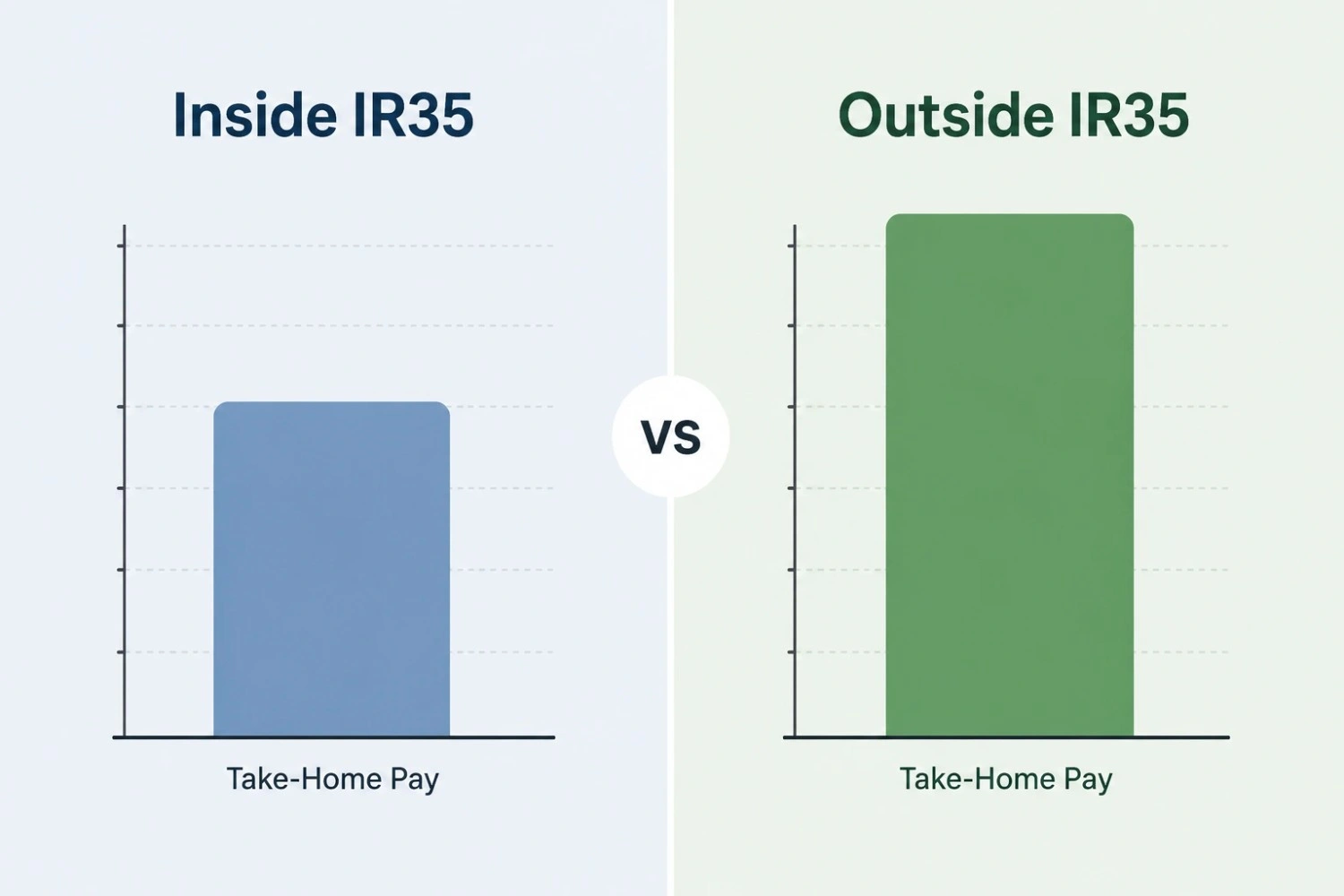
When you are inside IR35, your earnings count as deemed salary. Income tax and National Insurance come out through PAYE. You also pick up the employer's National Insurance bill, which comes out of your contract rate before you see a penny. This is why inside IR35 take-home sits at roughly 45 to 55 per cent of your gross contract value, well below the 70 per cent or more you can reach outside IR35 at the same rate.
Being inside IR35 is not the end of the world. For short contracts, roles that are hard to defend as outside IR35, or contractors who want less admin, it can make sense. But you need to know the numbers before you sign.
Inside IR35 and umbrella companies
Most inside IR35 contractors use an umbrella company to handle PAYE. The umbrella takes you on as an employee, collects your contract income from the agency or client, deducts the employer's NI, the apprenticeship levy and its own fee, then pays you through standard payroll.
Watch for numbers that look too good. No legitimate umbrella can get you more take-home than the PAYE formula allows — HMRC sets that formula. If an umbrella is promising figures that seem too generous, ask how. Non-compliant schemes have faced HMRC enforcement action, and the contractors caught up in them got the tax bill.
What does outside IR35 mean?
Outside IR35 means your contract has been assessed and the working relationship counts as genuine self-employment. You are providing a service through your limited company, not acting as a disguised employee. HMRC does not require PAYE.
Outside IR35 contractors usually pay themselves a low salary around the National Insurance threshold and take the rest as dividends from their limited company. Dividends carry a lower tax rate than employment income, and the company pays corporation tax rather than full PAYE rates. That is why outside IR35 produces noticeably higher take-home at the same contract rate.
You can also run legitimate business expenses through the company account, such as accountancy fees, subscriptions, equipment and travel to non-regular sites. These cut your corporation tax bill and keep more money in your pocket.
Outside IR35 does mean more admin. You need a limited company and an accountant. Your contract wording and actual working practices must line up; otherwise your status becomes hard to defend. Our guide to what an outside IR35 contract needs to contain covers what to look for.
Outside IR35 and limited companies
A limited company is the structure that makes outside IR35 work. You own the company, the company holds the contract, and the company pays you. You are the director and, in most cases, the only employee.
Since the 2021 off-payroll reform, the end client determines your IR35 status for medium and large businesses, not you. Small companies are exempt. A client is small if it meets two of these three: under 50 employees, turnover under £10.2 million, or a balance sheet under £5.1 million. If your client qualifies, you still make your own determination.
Inside vs outside IR35: side-by-side comparison
Here is a direct comparison. The financial difference is real. At a £500 day rate, the annual take-home gap between inside and outside IR35 can top £20,000.
| Factor | Inside IR35 | Outside IR35 |
|---|---|---|
| Tax treatment | Full PAYE income tax, plus employee and employer NI on all earnings | Salary and dividends mix through a limited company |
| Who decides status | End client (medium and large companies, post-2021) | End client or contractor (small company exemption) |
| Take-home pay | Roughly 50–55% of gross contract value | Typically 70–75% of gross at the same day rate |
| Pension options | Auto-enrolment via umbrella (min. 5% employee + 3% employer) | Flexible contributions through the limited company |
| Expenses | Very limited; no travel to the regular workplace | Legitimate business expenses deductible by the company |
| Admin burden | Low — the umbrella handles payroll and compliance | Higher — requires a limited company and an accountant |
Difference between inside and outside IR35 for contractors.
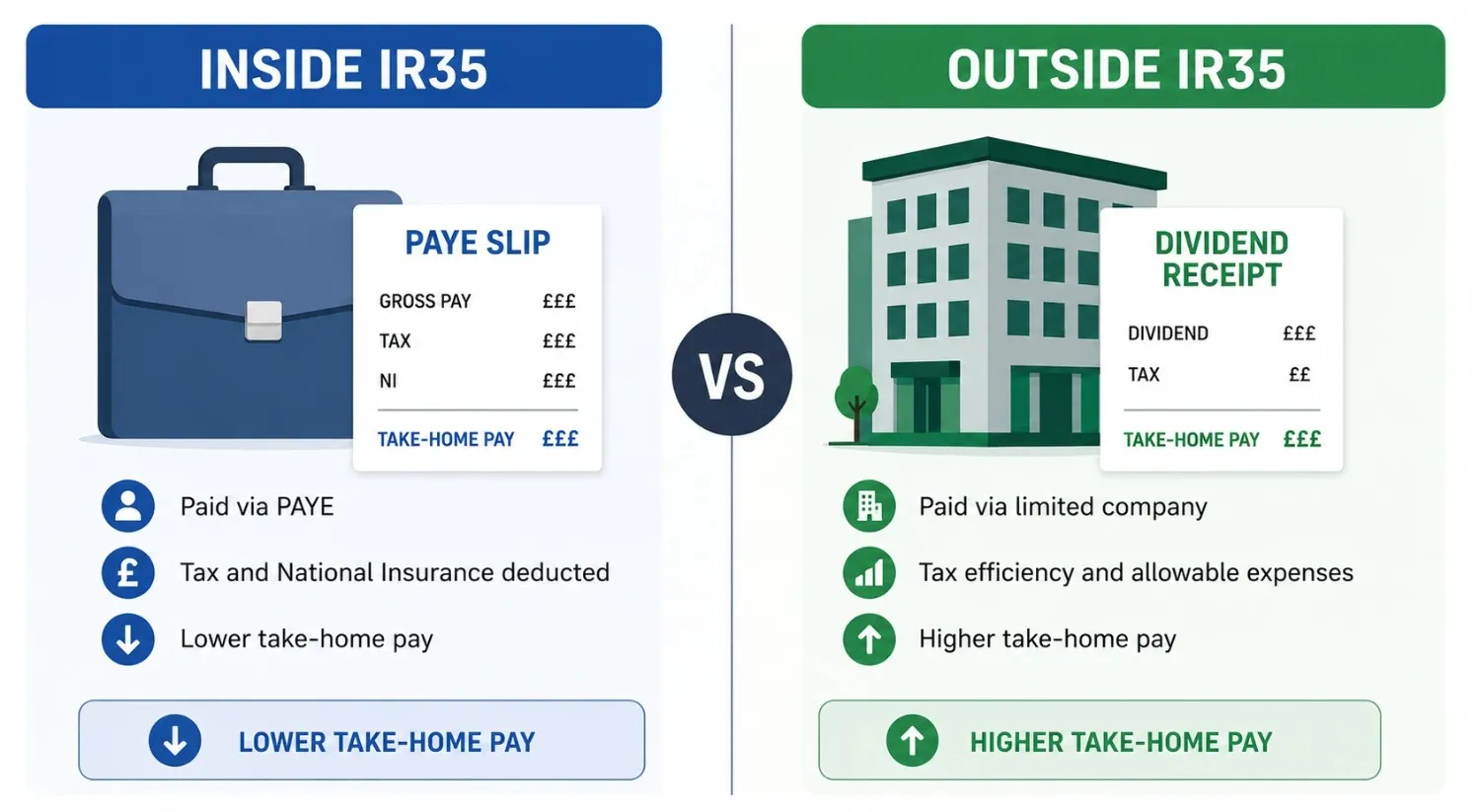
The 20 per cent rule of thumb. To match the take-home of a £500 outside IR35 contract, you need around £600 per day inside IR35, once pension, tax efficiency and the loss of expense deductions are in the picture. Your exact number will vary, but it is a solid starting point when comparing offers.
How is IR35 status decided?
IR35 status is a legal judgment. No calculator, including this one, can give you a definitive answer. What the calculator can do is show you the financial impact of each scenario, so you know what is at stake.
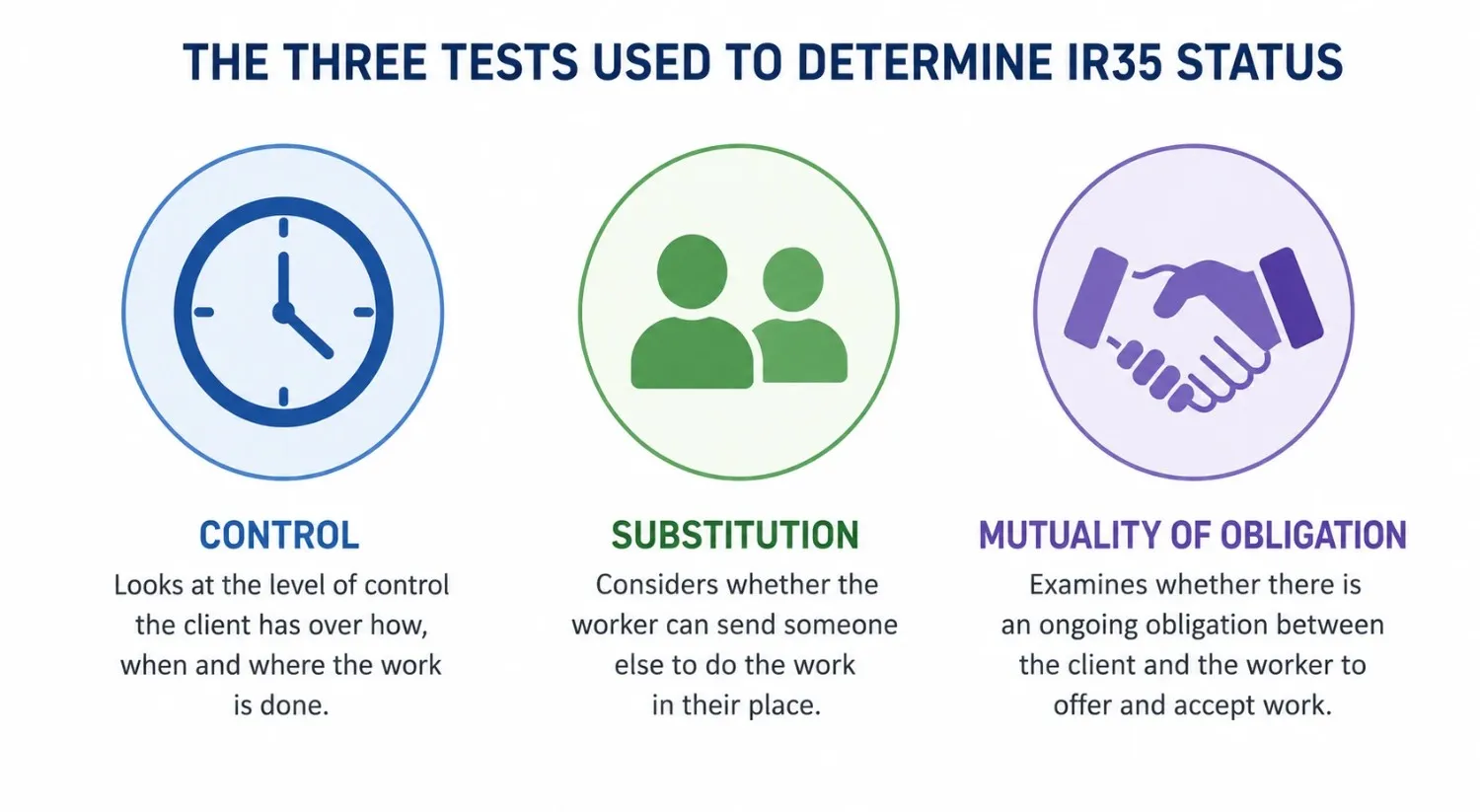
Status comes down to the actual working relationship between you and the end client. Three tests carry the most weight.
The three IR35 tests
Personal service and substitution
Can you send a substitute to do the work? A real right of substitution is one of the strongest signs of outside IR35 status. It has to be genuine — a clause that exists only on paper, where the client would never actually accept a replacement, carries little weight.
Control
Does the client control how, when and where you work? The more the client dictates your hours, location and methods, the more the arrangement looks like employment. Outside IR35 contractors decide how the work gets done.
Mutuality of obligation
Is the client obliged to keep offering you work, and are you obliged to keep accepting it? Permanent employment has that dynamic built in. Real contracting does not — the project ends and both sides move on.
Three tests used to determine IR35 status.
Other factors matter too: financial risk (do you carry the cost if work goes wrong?), integration (how embedded are you in the client's organisation?), and whether you use your own equipment or the client's.
HMRC's CEST tool covers most of these factors and gives a provisional result. It is not always legally binding, and it skips mutuality of obligation. For a more thorough assessment, the IR35 checker walks through the full checklist and explains what to do next.
What contractors are actually getting inside IR35
Contractors comparing real-world take-home figures is a constant topic. A thread started by a contractor weighing up roles at £450–£500 per day inside IR35 drew candid responses from people at a range of day rates.
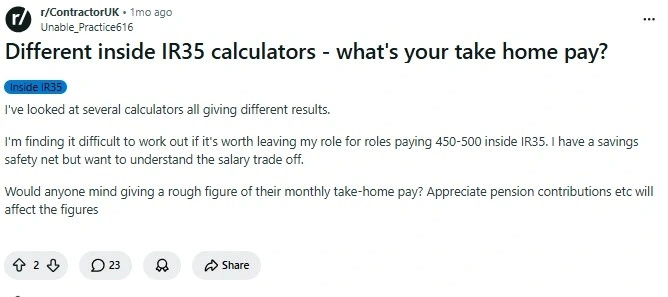
The answer that kept coming up: inside IR35 gives you roughly half your gross contract value as take-home. The top comment put it plainly — you are PAYE, and the umbrella fee is the only real variable between providers.
The more useful part of the thread was the breakdown of why calculators diverge. Tax rates are not the issue; those are fixed. It is the assumptions. Working days are the main one. Most calculators set 260 days. Contractors who track their actual time tend to land at 220 to 234, once holidays, gaps and bank holidays are counted. That gap inflates gross income by 10 to 15 per cent in most tools.
On the numbers: at £700 per day inside IR35, contractors reported £1,450 to £1,950 per week take-home. At £750 per day, figures of £6,000 to £7,500 per month came up. The variance was almost entirely down to salary sacrifice and tax code differences.
When comparing inside and outside offers, the 20 per cent uplift rule kept surfacing. At £500 per day outside IR35, you need around £600 inside to land in a similar net position once pension, expenses and tax efficiency are factored in.
Inside vs outside IR35: what the numbers actually look like
The financial gap between inside and outside IR35 is bigger than most contractors expect. A few key things get missed when people run the numbers for the first time.
Inside IR35 means your full earnings are taxed as employment income. You pay income tax and National Insurance on everything. Auto-enrolment pension contributions also typically apply — five per cent from you and three per cent from the umbrella. Those are not optional once you earn above the threshold.
Outside IR35, you work through a limited company. You draw a low salary, usually around £12,570, to use up the personal allowance and take the rest as dividends. The basic rate dividend tax is 8.75 per cent; at the higher rate it is 33.75 per cent. Compare that to 40 per cent income tax on employment income in the same bracket. The company pays corporation tax too, but the combined rate still beats PAYE for most contractors.
Dividend tax rates have gone up in recent years, so the gap between inside and outside IR35 is narrower than it was. But outside IR35 still typically returns 15 to 25 per cent more take-home at the same day rate. To match £500 per day outside IR35, an inside contract needs to offer around £600. That is before you factor in expenses, which outside IR35 contractors can claim through the company and inside IR35 contractors mostly cannot.
Final thoughts: use the calculator as a starting point
This calculator gives you a fast, clear comparison between inside and outside IR35 take-home pay. Use it before you accept a contract, when you are benchmarking a rate, or when you want to understand the financial stakes before getting a proper IR35 assessment.
It cannot tell you your IR35 status. That is a legal call based on your contract and how you actually work day to day. If you are not sure of your status, or you want to challenge a determination your client has issued, start with HMRC's CEST tool and consider an independent review if the contract value makes it worthwhile.
To go deeper on the legislation, the IR35 rules explained covers the full history, the 2017 and 2021 reforms, and what compliance looks like in practice.
IR35 calculator FAQs
Yes. Inside IR35 means your full contract income goes through PAYE, including employer National Insurance, which comes out of your rate before you see it. At the same day rate you will typically take home 15–25% less than you would outside IR35.
Yes. IR35 status is assessed contract by contract. You can have one client inside IR35 and another outside at the same time. Each engagement needs its own assessment.
At a £500 day rate, inside IR35 through an umbrella typically returns around £5,500–£6,000 per month take-home. Outside IR35 through a limited company at the same rate typically returns £7,000–£8,000 or more, depending on how you structure your income.
No. HMRC does not offer a take-home pay calculator. Its free CEST tool determines whether your contract falls inside or outside IR35 — it does not calculate pay.
Yes. This calculator shows monthly and annual figures. Enter your day rate or annual contract value and select your IR35 status.
Ours does. There is an optional pension field for salary sacrifice contributions. This is useful if you are approaching the £100,000 adjusted net income threshold, where the personal allowance starts to taper.
Accurate for estimating tax, which is what they are built to do. Results vary across tools because of the assumptions each makes: working days (220 vs 260), apprenticeship levy treatment, and how salary sacrifice is handled. Our calculator states its assumptions clearly.
Yes. HMRC investigates non-compliant umbrellas. If an umbrella promises significantly more take-home than standard PAYE maths produces, that is a warning sign. Every legitimate umbrella follows the same PAYE formula — the only difference is the fee.
No. An umbrella is a payroll mechanism, not an IR35 category. Most umbrella workers are inside IR35, but the status depends on the contract, not on whether an umbrella is involved.
See what you would actually take home.
Enter your day rate once and compare inside and outside IR35 side by side. Free, no signup.